
“Water-based” doesn’t tell you whether a marker will wipe off a window or suit your chalkboard. With water-based paint markers, the ink type, surface and clean-up instructions all matter. The UNI liquid chalk marker guidance discussed here describes marks as smudge-resistant on non-porous surfaces and removable with a damp cloth. Don’t assume that applies to every board, coating or material.
For a café menu, window display or creative project, first match the tip to the size of your lettering, then check the surface guidance. This guide compares fine, medium, broad and extra-broad formats, along with classic, fluorescent and metallic colour options. It also explains what “water-based” does and doesn’t tell you about clean-up, and what to check when comparing individual markers with assorted wallets.
Key Takeaways
- Check the intended surface and clean-up guidance. The water-based label alone doesn’t tell you how a marker will behave.
- Match the tip to the lettering: finer formats suit smaller writing, while broader chisel tips make larger marks.
- Compare classic, fluorescent and metallic colours against your background and the visibility you need.
- Before choosing an individual marker or assorted wallet, check the listed tip format, palette and pack contents.
Water-Based Paint and Liquid Chalk Markers Explained
“Water-based paint markers” describes an ink category, not how a mark will behave on every surface. Formulas are made for different uses, so the label alone won’t tell you whether a mark will wipe away, stay put or suit a particular material. A paint marker is a broad category. Before starting, check the specific product’s ink type, intended surface and clean-up instructions.
This guide discusses UNI liquid chalk markers described for glass, chalkboards and other non-porous surfaces. Their product guidance says marks are smudge-resistant on non-porous surfaces and can be cleaned with a damp cloth. Treat this as surface-specific guidance, not a guarantee for every board or finish. If you’re unsure, test a small, inconspicuous area first.
Water-based paint markers versus liquid chalk markers: what should shoppers check?
Start with the job and the material. Liquid chalk markers are the focus here; acrylic paint markers are a separate type, and “water-based” doesn’t make the two interchangeable. If you need a mark to be removable, check the exact marker’s surface guidance and clean-up directions before using it.
For a separate look at POSCA markers, browse the POSCA marker range. PoscART specialises in genuine POSCA markers and official accessories, with tip options ranging from ultra-fine to extra-broad. You can also use the liquid chalk marker range link to review the chalk-marker information discussed in this guide. Match the marker type to your material rather than relying on the water-based label alone.
How to Choose Water-Based Paint Markers by Tip, Colour and Project
Begin with the space available and how far away people will read your lettering. A small note beside a window illustration needs a different tip from a bold heading across a shopfront. The UNI liquid chalk marker formats described here range from fine bullet tips to wider chisel tips. Choose a size that suits the layout instead of expecting one marker to handle every task.
Which tip size suits small messages, menus and bold window lettering?
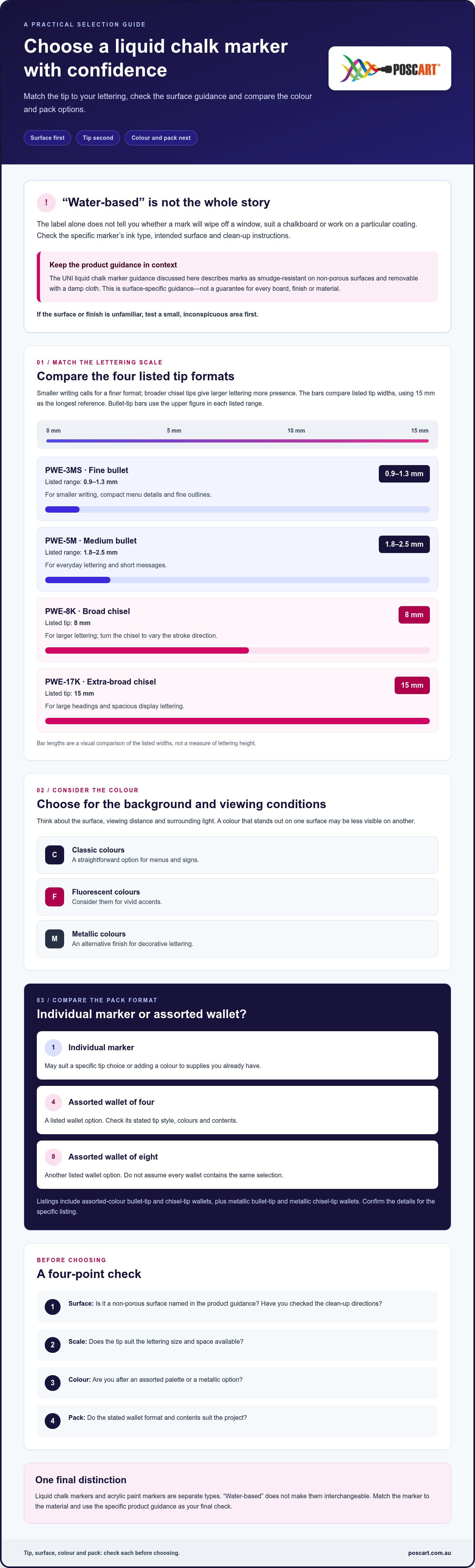
- PWE-3MS fine bullet: The listed 0.9-1.3 mm range suits smaller writing, compact menu details and fine outlines.
- PWE-5M medium bullet: With a listed 1.8-2.5 mm range, it’s suited to everyday lettering and short messages.
- PWE-8K broad chisel: Its 8 mm tip gives larger lettering more presence. Turn the chisel to vary the stroke direction.
- PWE-17K extra-broad chisel: At 15 mm, it suits large headings and spacious display work.
Choose colour with the background and viewing conditions in mind. Classic colours can keep menus and signs simple to read. Fluorescent options may work for vivid accents, while metallic colours give decorative lettering a different finish. Check the available palette and consider the background, viewing distance and surrounding light. A colour that stands out on one surface may be less visible on another.
Before choosing, confirm the marker’s stated surface and clean-up guidance. The product guidance discussed here describes smudge resistance on non-porous surfaces and removal with a damp cloth, but texture and coating can affect results. Test a small, inconspicuous area first, especially when the finish is unfamiliar. To review the listed formats, visit the liquid chalk marker range.
Which UNI Liquid Chalk Markers Should You Compare Before Buying?
Once you’ve checked the surface and lettering scale, compare the listed UNI formats and pack options. The formats described here include the PWE-3MS fine bullet, PWE-5M medium bullet, PWE-8K broad chisel and PWE-17K extra-broad chisel. These distinctions help you narrow your choice, whether you’re writing small notes, creating regular signage or planning larger display lettering.
Individual markers or assorted wallets: which format fits your project?
An individual marker may suit you if you need a particular tip or want to add a colour to supplies you already have. Assorted wallets of four and eight provide another way to compare formats and palettes. The listings include assorted-colour bullet-tip and chisel-tip wallets, as well as metallic bullet-tip and metallic chisel-tip wallets. Check each listing for its stated tip style, colours and pack contents. Don’t assume every wallet contains the same selection.
Use this quick check before you decide:
- Surface: Is it one of the non-porous surfaces named in the product guidance, and have you checked the clean-up directions?
- Scale: Does the tip suit the size of your lettering and the space available?
- Colour: Do you need an assorted palette, or are you looking for a metallic option?
- Pack: Does the listed wallet format and its stated contents suit your project?
“Water-based paint markers” doesn’t tell you on its own how a marker will behave on a surface. Use the product guidance as your final check. Once you’ve confirmed the surface, tip and palette, review the liquid chalk marker collection information to compare the listed formats and wallets.
Choose Your Chalk Marker with Confidence
Start with your surface and clean-up needs, then consider the scale of your lettering. Fine and medium bullet tips suit smaller details and everyday writing, while broad and extra-broad chisel tips make larger marks. The product information discussed here also lists classic, fluorescent and metallic colour options for signage and creative projects.
Compare each listing’s tip style, palette and pack contents, and follow its surface guidance before you begin. If you’re also considering paint markers beyond liquid chalk, PoscART’s range focuses on genuine POSCA markers, with options including the PC-5M medium bullet tip and other tip sizes.
For liquid chalk marker listing details, review the UNI liquid chalk marker range. To explore PoscART’s POSCA options, browse the POSCA marker range and compare tip styles for your project.
Frequently Asked Questions
Are water-based paint markers permanent?
Not necessarily. “Water-based” describes an ink category, not whether a mark is permanent or removable. The UNI liquid chalk marker guidance discussed here says marks can be cleaned from non-porous surfaces with a damp cloth, but don’t assume that applies to every material. Check the product’s surface guidance and test a small, inconspicuous area before lettering a finished sign or display.
Can liquid chalk markers be used on glass and chalkboards?
The UNI liquid chalk markers covered in this guide are described for glass, chalkboards and other non-porous surfaces. Their product guidance also describes the marks as smudge-resistant on non-porous surfaces. Chalkboards can differ in coating and texture, so test an inconspicuous spot first, especially if you’re unsure whether the board is porous.
How do you remove water-based liquid chalk marker from a surface?
For the non-porous surfaces covered by the product guidance, wipe the marks with a damp cloth. This is the stated clean-up method for these liquid chalk markers, not a guarantee for every surface or finish. If the material is textured, coated or porous, test a small area first and check the marker’s instructions before cleaning a larger design.
Which chalk marker tip is best for small writing or large signs?
For small writing, consider the PWE-3MS fine bullet tip, listed at 0.9-1.3 mm. The PWE-5M medium bullet tip is listed at 1.8-2.5 mm for general lettering. For larger signs, compare the PWE-8K broad chisel tip at 8 mm with the PWE-17K extra-broad chisel tip at 15 mm. Choose according to your layout and viewing distance.
General Information
This article is provided as general information only to help customers compare and choose POSCA markers, acrylic markers, art supplies, creative tools and related products. Product details, colours, finishes, surface suitability, availability, pricing and usage results may vary. Always check the individual product page, manufacturer information, age guidance, surface instructions and safety recommendations before purchasing or using a product.


