


How to Use POSCA
POSCA is easy once you know three things: how to wake the pen up, how to prepare the surface, and whether your project needs sealing. This guide covers all of it, with the official uni diagrams. It takes about five minutes to read and will save you a ruined piece.
Looking for a short answer instead? Try the FAQ.
- 1. Parts of a marker
- 2. Pick your tip size
- 3. Starting your pen
- 4. Surface prep & fixing
- 5. Care & maintenance
- 6. Techniques
- 7. Safety
Know your marker
A POSCA isn't a felt pen. Inside the barrel is water-based pigment paint and a mixing ball; the tip sits on a valve that only opens when you press it down. That's why a new pen writes nothing until you prime it — and why shaking matters.
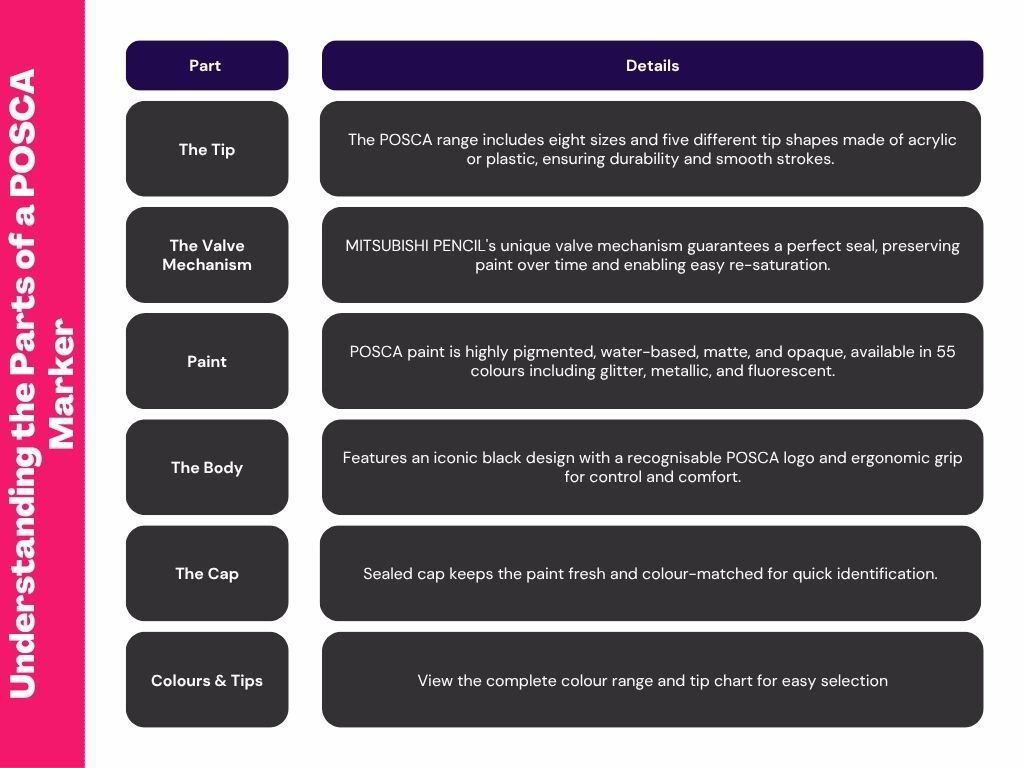
The parts of a POSCA marker.
Tips on most sizes are replaceable, and the PC-3M and PC-5M nibs are reversible — bullet at one end, chisel at the other. Shop replacement nibs
Pick your tip size
Ten tips, one paint. The code on the barrel tells you the line it draws — everything else about the pen is the same. Pick the line you want and the code follows.
| Code | Line | What it's for |
|---|---|---|
| PC-1MR | 0.7mm pin | The finest POSCA. Outlines, lettering, tiny detail on rocks and models. |
| PC-1M | 0.7–1mm bullet | Fine lines and small text with a touch more flow than the 1MR. |
| PC-3M | 0.9–1.3mm bullet | The everyday fine pen — detail plus enough coverage to colour in. The favourite for journalling and illustration. |
| PC-5M | 1.8–2.5mm bullet | The do-everything POSCA and the widest colour range. If you buy one, buy this. |
| PCF-350 | 3–10mm brush | Flexible brush for thick-to-thin strokes, lettering and painterly work. |
| PC-7M | 4.5–5.5mm bullet | Fills shapes fast — posters, canvas, boards. |
| PC-8K | 8mm chisel | Wide flat strokes and crisp edges — window art, signage, murals. |
| PC-17K | 15mm chisel | The biggest POSCA. Street art, large surfaces, big backgrounds. |
| PCM-22 MOP'R | 3–19mm mop | Round mop tip for washes, drips, splashes and bold large-scale coverage. |
| PC-5BR | Brush | Expressive, painterly marks with a springier tip than the PCF-350. |
Which tip for which surface?
- Paper, card, sketchbooks — 1MR, 1M, 3M, 5M.
- Rocks, wood, ceramics — 3M and 5M for detail, 7M or 8K for base coats.
- Fabric & sneakers — 3M and 5M, then heat-set.
- Glass, windows, café boards — 5M, 8K, 17K.
- Murals and large-scale — 7M, 8K, 17K, MOP'R.
Buying your first POSCA? A PC-5M set gives you a working palette in the most useful size and the widest colour choice. Add a PC-3M for detail and a white PC-1MR for highlights and you can draw almost anything.
Starting a new pen
- Shake with the cap on until you hear the ball rattle — around 20 shakes. This mixes the pigment back through the paint.
- Press the tip down on scrap paper. Straight down, hold a second, lift. Repeat.
- Wait for the colour. Most pens take 5–10 presses. White, the metallics and the broad tips take longer because there's more tip to fill.
- Test a line before you touch the real thing.
Don't over-pump. A flooded tip drips and takes a while to settle. If it happens, stand the pen tip-up with the cap off for a few minutes and dab the excess onto scrap.
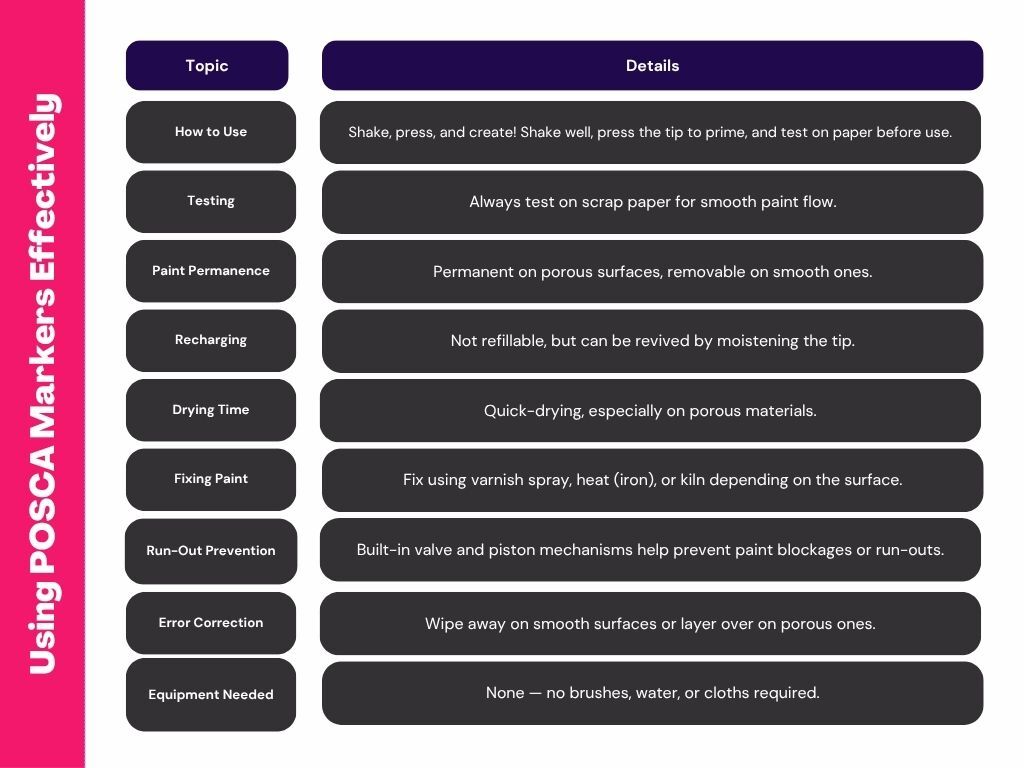
Priming, testing, drying and fixing.
Preparing the surface & making it stay
Every surface falls into one of two camps, and which camp it's in decides everything.
Porous surfaces — it soaks in and stays
Paper, card, canvas, raw wood, stone and pebbles, terracotta, unglazed ceramic, fabric. Clean and dry is all the prep you need; sand timber smooth and dust it off. Once dry the paint is there for good — no sealing required unless the piece lives outdoors or gets handled hard.
Non-porous surfaces — it sits on top
Glass, glazed ceramic, smooth metal, PVC-type plastic, laminate. Wipe with methylated spirits first so there's no grease. The paint will wipe off with a damp cloth until you fix it — brilliant for window art you change each season, a problem for a mug you want to keep.
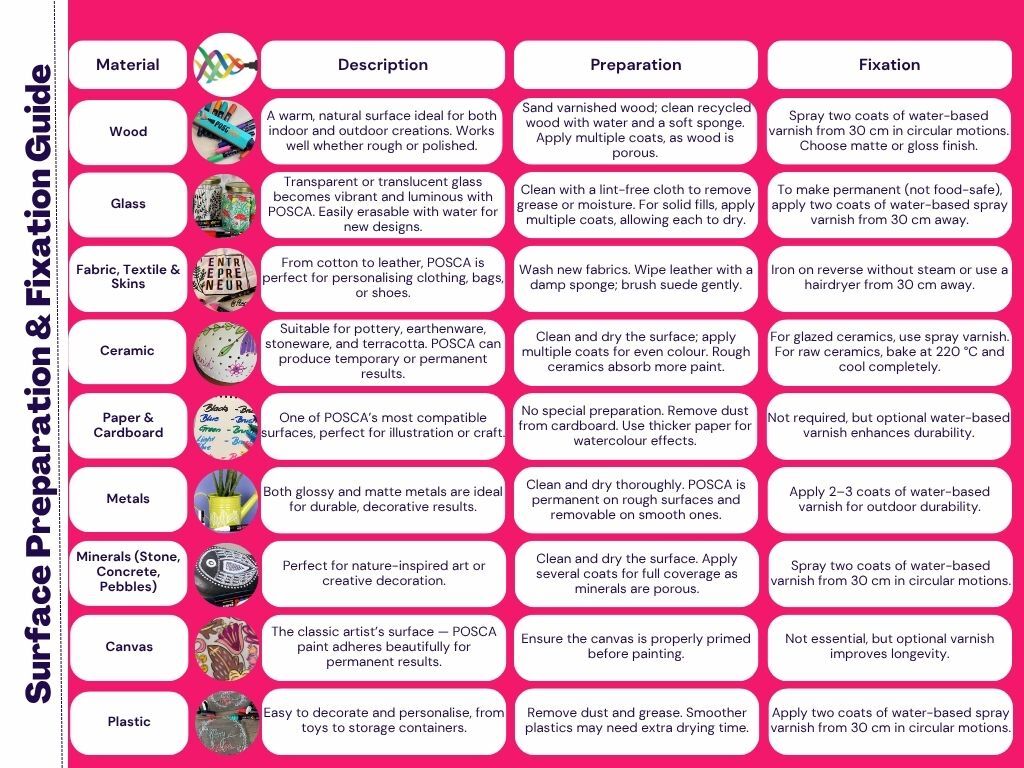
Surface preparation and fixation, surface by surface.
Three ways to fix it permanently
- Varnish — let it dry 24 hours, then spray clear acrylic varnish in several light passes from about 30cm. One heavy wet coat can reactivate the paint and smear it. Test on a scrap first.
- Bake (glass and ceramic) — dry fully, place in a cold oven, bring up to around 160°C, hold about 45 minutes, then let it cool in the oven so it doesn't crack. Decorate the outside only and stay below the rim. Hand wash afterwards.
- Iron (fabric) — dry fully, turn inside out, put a cloth between iron and fabric, press with a dry iron, no steam, for a couple of minutes. Then wash inside out, cold, and skip the dryer.
Care & maintenance
POSCA pens last for years if you look after the tip — which is where almost every problem starts.
- Dry tip? Pull it out with tweezers, soak in warm water until the dried paint releases, squeeze out, dry, refit, shake and re-prime.
- Dirty tip? It has picked up colour from paint that wasn't dry. Press on scrap until its own colour returns, or rinse the tip under warm water.
- Worn tip? Replace it — a new nib costs a fraction of a new pen.
- Storage: cap on firmly, out of heat and sun. Brush tips flat, everything else upright.
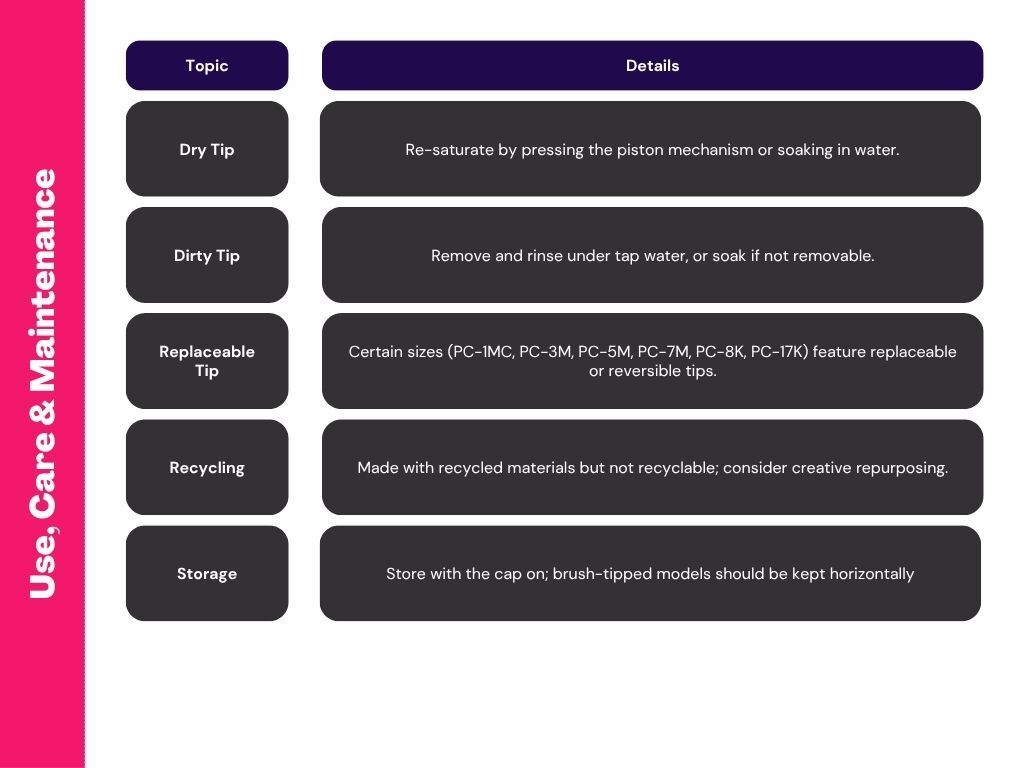
Use, care and maintenance.
Techniques worth learning
- Layering. POSCA is opaque, so light goes over dark. Let each layer dry completely or the tip lifts the colour underneath.
- Blending. Work two colours together while wet, or soften an edge with a damp brush — water reactivates POSCA right up until it dries.
- Water effects. A wet brush turns fresh POSCA into a wash. Great for skies and backgrounds.
- Mixing. Put two colours on a palette or a tile and mix them like paint before you apply.
- Drips and splashes. The MOP'R (PCM-22) and the broad tips hold enough paint to drip on purpose.
- Blowing. A loaded tip plus a straw gives you the classic splatter burst.
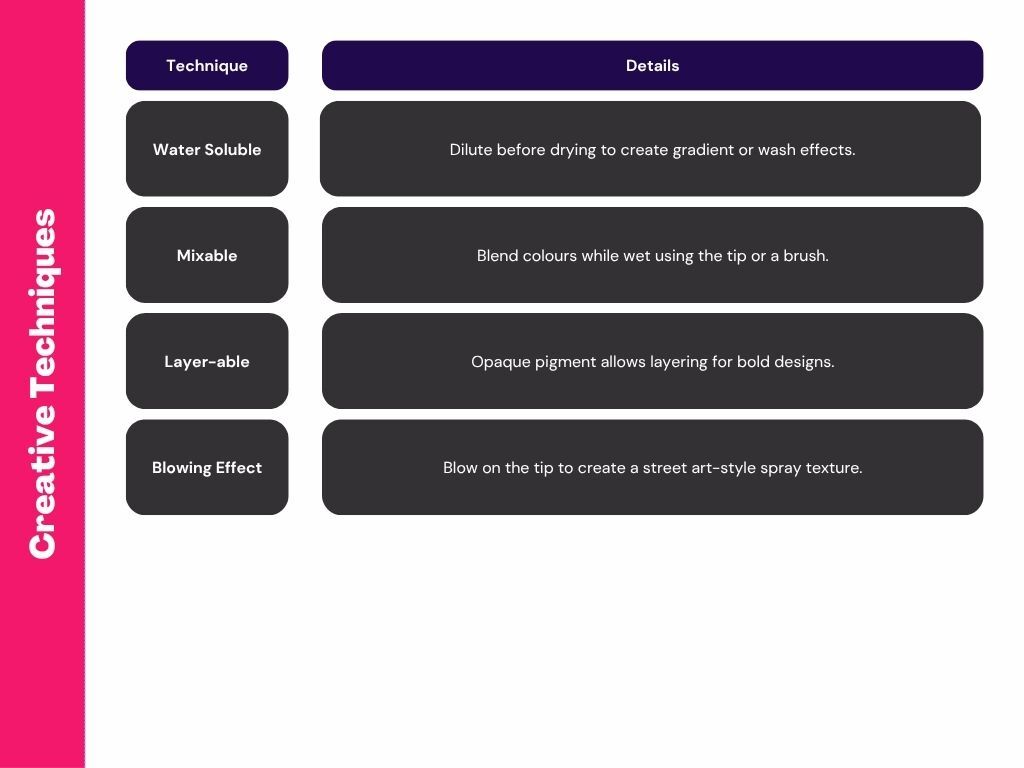
Creative techniques.
Safety and sensible use
POSCA paint is water-based, non-toxic and odourless, which is why it's a classroom staple — no solvent fumes. A few rules still apply:
- Fine for children with normal supervision. Caps are small, so keep them away from toddlers.
- Not approved for skin, face or cosmetic use. Use proper body paint for that.
- Decorate mugs and glasses on the outside only, below the rim, and hand wash.
- Only mark property you own or have permission to mark.
- Cover the table. POSCA is designed to stay put — see the FAQ on getting it off things if it doesn't go to plan.
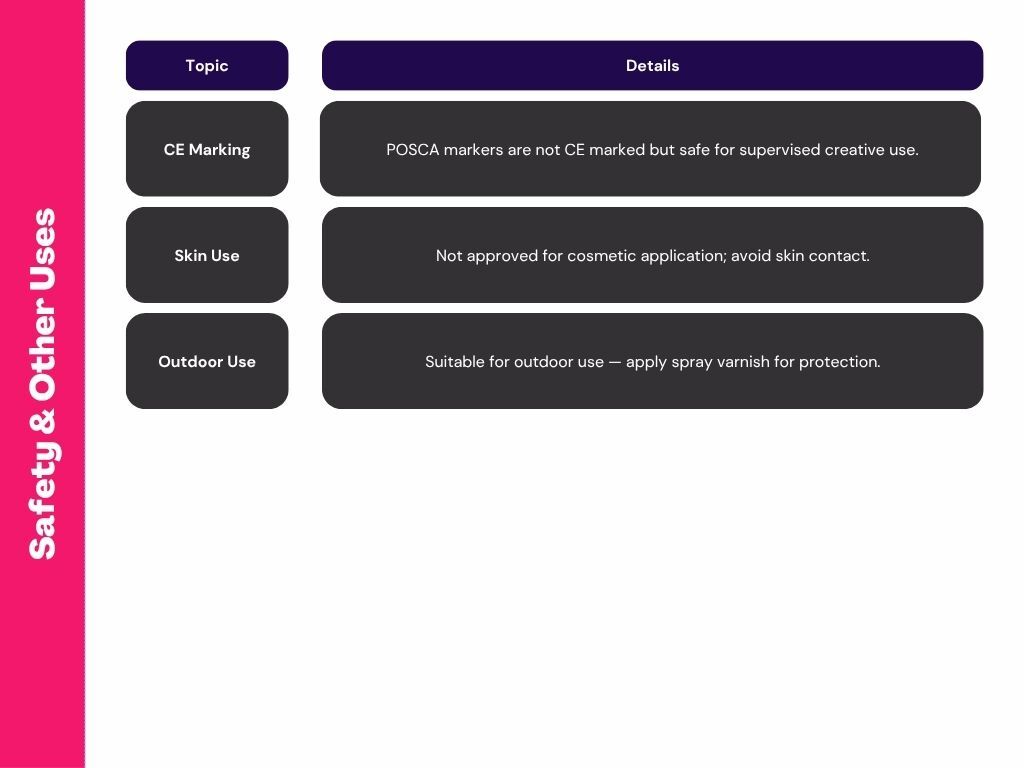
Safety and other uses.
Ready to start?
Individual pens · Sets & bundles · Replacement nibs · Download the official POSCA guide & colour chart
Questions we haven't answered? The FAQ covers about forty of them, or call 1300 783 961 and talk to someone who uses these pens.